By Dr. Kiran Yadav, MBBS, DGO, DNB (Obstetrics & Gynaecology) · Gurugram
“Normal delivery kaise hoti hai, aur uski taiyari kaise karein?” (नॉर्मल डिलीवरी की तैयारी कैसे करें?) is a question I hear every week.
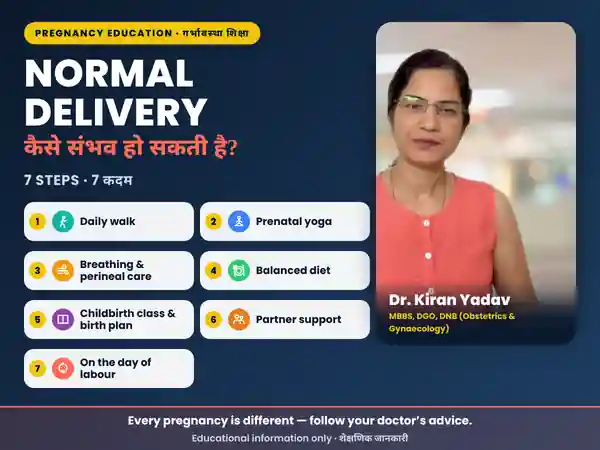
No habit can guarantee a normal delivery, because every pregnancy and labour is different. But a few simple steps can help you stay fit, calm and informed for labour and delivery. Here are seven.
🚶♀️ 1. Walk daily
Walking is the simplest pregnancy exercise for normal delivery. If your doctor says it is safe, ACOG advises about 150 minutes of moderate activity a week [1]. Walk at a pace where you can still talk. Stop and call your doctor if you feel dizzy, have pain, bleeding or leaking fluid.
🧘♀️ 2. Prenatal yoga
Gentle prenatal yoga can ease stiffness, improve posture and help you relax. Learn from a trained prenatal instructor and begin only with your doctor’s OK. Avoid hot yoga, deep twists and any pose that hurts.
😮💨 3. Breathing and perineal care
Practise slow, deep breathing for a few minutes a day, so you can use it when contractions come. Keep your pelvic floor strong with Kegel exercises. In late pregnancy, a doctor may also teach gentle perineal massage. Studies suggest that pelvic floor exercises with perineal massage may lower the chance of perineal tears [6]. Ask your doctor to show you the right method first.
🥗 4. Eat well
No food guarantees a normal delivery, but a balanced diet supports you and your baby [7].
- Eat dal, vegetables, fruit, whole grains, milk or curd, and eggs or paneer.
- Drink enough water.
- Take iron, folic acid and calcium only as your doctor prescribes.
- Avoid raw or undercooked meat and unpasteurised milk.
📘 5. Childbirth class and birth plan
A childbirth class explains the stages of labour, pain-relief options, hospital routine and newborn care. A birth plan is a one-page list of your wishes: who will be with you, positions you prefer, and your thoughts on pain relief. Share it with your doctor early, and stay flexible, because labour can change plans.
🤝 6. Partner support
WHO recommends having a companion of your choice during labour [4]. A Cochrane review found that continuous support in labour may improve outcomes, including more spontaneous vaginal births and shorter labours [5]. Your partner (or mother, or another trusted person) can attend classes, practise breathing with you, give a massage, hold your hand and speak up with the care team.
🏥 7. Labour day: what to expect
Labour has usually started when contractions become regular, stronger and closer together, or when your water breaks. Stay hydrated, keep moving or change positions, use your breathing, and trust your team [2]. Labour is painful for most women, and options such as an epidural are available, so discuss them beforehand. If you need help, such as an assisted delivery or a C-section, it is done for your and your baby’s safety. It is not a failure.
⚠️ Contact your doctor or hospital if you have
- Water breaking or fluid leaking
- Bleeding
- Your baby moving less than usual
- Regular contractions before 37 weeks
- Severe headache, blurred vision, or swelling of the face and hands
- Fever or severe, constant belly pain
✅ Do and ❌ Don’t
| Do | Don’t |
|---|---|
| Keep all antenatal check-ups | Start a new exercise without your doctor’s OK |
| Practise breathing and pelvic floor exercises | Try home “remedies” to start labour |
| Attend a childbirth class | Skip check-ups |
| Pack your hospital bag and plan transport | Ignore reduced baby movements |
Frequently Asked Questions
Normal delivery kaise hoti hai? (नॉर्मल डिलीवरी कैसे होती है?)
In a normal (vaginal) delivery, labour contractions open the cervix, the baby moves down the birth canal and is born, and the placenta follows. Your care team watches you and your baby throughout.
How do I prepare for normal delivery?
Follow the seven steps above, attend regular check-ups, and discuss your plan with your doctor.
Can everyone have a normal delivery?
No. It depends on the baby’s position, the placenta, your health and how labour progresses. A C-section is a safe option when it is needed [8]. Read more about normal and high-risk pregnancy and C-section.
Which exercises are commonly advised?
Walking, prenatal yoga, pelvic floor exercises and breathing practice, with your doctor’s approval.
Does diet decide the type of delivery?
No. A balanced diet supports a healthy pregnancy, but it cannot guarantee a normal delivery.
Is normal delivery painful?
Most women feel labour pain, and it varies from person to person. Breathing, movement, massage, warm compresses and an epidural are options. Plan them with your doctor.
How do I know labour has started?
Regular contractions that get stronger and closer, or your water breaking. Call your doctor or hospital.
Is water birth safe?
Warm-water immersion in early labour may be an option for some healthy women where facilities exist. ACOG does not recommend delivering the baby underwater [3]. Discuss it with your doctor.
Can I have a normal delivery after a C-section?
Some women can try a vaginal birth after caesarean (VBAC) after careful assessment. It depends on your history, the scar and the hospital’s facilities.
Where can I get pregnancy and delivery care in Gurugram (Gurgaon)?
Dr. Kiran Yadav, Gynaecologist, practises at Motherhood Hospital, Sector 57, Gurugram, and Arogyam Care Clinic, G21-22, Ocus Quantum, Sector 51, Gurugram 122003. Phone: 8860218789. This is general information; choose a doctor and hospital that suit your needs.
Related Video
Watch Dr. Kiran Yadav explain these seven steps in Hindi/Hinglish: Normal Delivery Tips: 7 Steps. The video is general health education and not personal medical advice.
References
- ACOG Committee Opinion No. 804: Physical Activity and Exercise During Pregnancy and the Postpartum Period (2020).
- ACOG Committee Opinion No. 766: Approaches to Limit Intervention During Labor and Birth (2019).
- ACOG Committee Opinion No. 679: Immersion in Water During Labor and Delivery (2016).
- WHO. Recommendations: Intrapartum Care for a Positive Childbirth Experience (2018).
- Bohren MA, et al. Continuous support for women during childbirth. Cochrane Database Syst Rev. 2017;7:CD003766. doi:10.1002/14651858.CD003766.pub6
- Cao X, et al. PFMT relevant strategies to prevent perineal trauma: a systematic review and network meta-analysis. Arch Gynecol Obstet. 2022;308(2):387–401. doi:10.1007/s00404-022-06769-w
- ICMR–NIN. Dietary Guidelines for Indians (2024).
- ACOG/SMFM Obstetric Care Consensus No. 1: Safe Prevention of the Primary Cesarean Delivery (2014).
This article is for health education only and is not a substitute for personal medical advice, diagnosis or treatment. Every pregnancy is different, and outcomes cannot be guaranteed.
Dr. Kiran Yadav — MBBS, DGO, DNB (Obstetrics & Gynaecology), practises at Motherhood Hospital, Sector 57, Gurugram, and Arogyam Care Clinic, G21-22, Ocus Quantum, Sector 51, Gurugram 122003.
Motherhood Hospital, Sector 57, Gurugram | Arogyam Care Clinic, Sector 51, Gurugram
Phone: 8860218789 | gynelap.com