Is it true that a woman is born with every egg she will ever have? Yes. Unlike sperm, which the body keeps making through adult life, the human egg supply is formed before birth and only goes down [2]. Older women are increasingly approaching fertility clinics in India [2], and two questions come up constantly: can egg count be increased? and can egg quality be improved? The honest answers are “no” and “partly, and with limits”.
Quick answer
Egg count is fixed before birth and only declines: roughly 1–2 million at birth, about 300,000–500,000 at puberty, around 25,000 by age 37, and about 1,000 at menopause (estimates vary between studies). No diet, supplement or approved procedure increases it. Egg quality (how chromosomally healthy an egg is) also declines with age, and age is its strongest determinant. Not smoking and a balanced diet are reasonable ways to support it. Evidence for specific supplements is limited and mostly comes from IVF patients.
How Egg Count Changes From Birth to Menopause
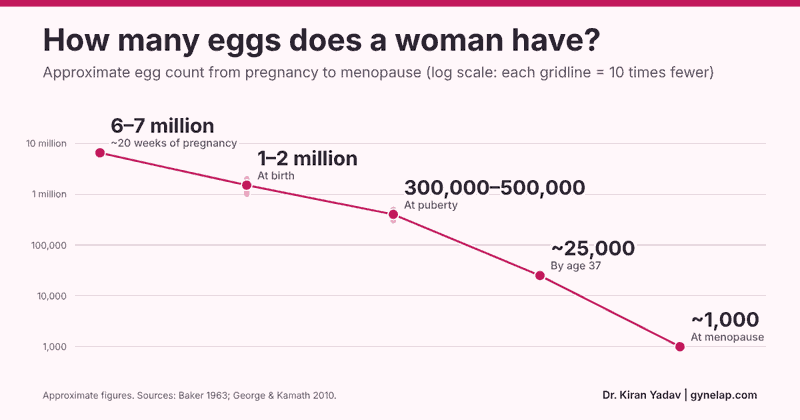
Well over 99% of eggs are never ovulated; the body simply breaks them down over the decades. Across Asian countries, the average age at natural menopause ranges from about 46 to 52 years [5].
Why Does the Decline Happen?
A female fetus’s ovaries form all their egg cells before birth and then stop, unlike sperm production in men [2]. Each month a group of eggs is recruited from the fixed reserve. Usually one is ovulated and the rest are lost. Follicular atresia continues with every cycle [2], so pregnancy, breastfeeding and hormonal contraception do not “save” eggs.
Egg Count vs Egg Quality: Two Different Things
- Count (ovarian reserve) is how many eggs remain.
- Quality is whether an egg can mature, divide its chromosomes correctly and form a healthy embryo.
With age, errors in chromosome division become more common, so the egg ends up with the wrong number of chromosomes (aneuploidy). Except in rare situations, an embryo formed from such an egg ends in miscarriage, which is why miscarriage and chromosomal conditions such as Down syndrome become more likely with age [3]. Mitochondrial dysfunction is among the leading mechanisms identified [3]. Age reflects both the quantity and the quality of eggs, which makes it the single most important factor in fertility assessment [2]. A woman can have a reasonable count but lower-quality eggs, or the reverse.
Can You Increase Your Egg Count?
No. Once the pool formed before birth is used up, it is not replaced, and nothing you eat or take changes that [2].
You may have seen “ovarian rejuvenation” with PRP (platelet-rich plasma) injections into the ovary. It is experimental. Early reports are small and uncontrolled, and a 2021 review in Human Reproduction concluded that immediate clinical use is premature [8]. A small rise in AMH is also not the same as new eggs. If anyone offers this, ask what controlled evidence supports it.
Can You Improve Egg Quality? What the Evidence Says
Early research suggests that some dietary and other interventions may mitigate age-related effects on egg quality [3], but nothing has been shown to reverse them. Most human data come from IVF patients or from associations in observational studies. Here is what we know:
| Measure | What the evidence shows | Limits |
|---|---|---|
| Not smoking, limiting alcohol | Smoking, alcohol, and stressful, physically demanding work were linked with earlier menopause in a meta-analysis of studies from across Asia [5] | Association, not proof of cause |
| Balanced “profertility”-style diet (whole grains, soy, seafood, low-pesticide fruit and vegetables, with folic acid, B12 and vitamin D supplements) | In one cross-sectional study of 185 women, closer adherence was linked with higher AMH and antral follicle count in overweight and obese women only [6] | One snapshot study; shows association, not cause; no link in normal-weight women |
| CoQ10 | A 2024 meta-analysis of 20 randomised trials (2,617 women with ovarian ageing, studied around fertility treatment) found more eggs retrieved, more high-quality embryos and higher clinical pregnancy rates with antioxidants. CoQ10 tended to work best, lower doses did better than higher ones, and the benefit was clearest in women under 35 with diminished ovarian reserve [7] | Studied around fertility-treatment cycles; may not apply to natural conception or to older women |
| Movement, sleep, stress | General health measures worth doing for their own sake | Direct proof that they improve egg quality is limited |
What this looks like on an Indian plate: whole grains such as brown rice, oats, jowar and bajra; pulses, chana, beans and tofu; plenty of colourful vegetables and fruit; nuts, flaxseed and walnuts (fish if you eat it); and dahi or buttermilk as part of everyday eating. These are good health habits, not a treatment for eggs.
A note on supplements: the right choice depends on your age, your blood levels and whether you are planning IVF. Evidence for other supplements, including omega-3 and vitamin D, is thin, and a documented deficiency is best corrected as part of general health. Do not self-prescribe doses; speak to your gynaecologist first, especially if you take other medicines.
Why Timing Matters More Than Any Supplement
Natural monthly fecundity is about 25% between ages 20 and 30 and falls to below 10% above 35; the decline usually starts around age 32 and drops sharply after 37 [2]. Lifestyle changes are worth starting, but they work best alongside a medical evaluation, not in place of one. Infertility is usually defined as not conceiving after a year of trying, but evaluation should start earlier in women aged 35 and above [2], so a gynaecologist’s assessment is the usual next step.
Knowing Where You Stand: AMH and Antral Follicle Count
Two tests estimate ovarian reserve: a blood test for AMH and an ultrasound antral follicle count (AFC) [2][4]. AMH is produced by small growing follicles and reflects how many are present [4]. It does not measure chromosomal quality, and neither test predicts fertility with certainty [2]. There is also no single “normal” AMH: levels peak in the early 20s and then decline towards menopause, and because there is no international assay standard, results differ between laboratories [4]. Compare results from the same lab and don’t over-read small changes. Data linking AMH to natural fertility are limited, so a low value does not by itself mean you cannot conceive, and a normal one is no guarantee [4].
Frequently Asked Questions
How many eggs does a woman have at birth?
Roughly 1–2 million, already down from the 6–7 million present around 20 weeks of fetal life. Estimates vary between studies.
Can egg count increase after birth?
No. The pool formed before birth is fixed and only declines. This is true regardless of diet, supplements or experimental procedures such as ovarian PRP.
Can egg quality be improved?
It can be supported but not reliably restored. Age remains the biggest factor. Not smoking and a balanced diet are sensible steps; evidence for particular supplements is limited and largely from IVF settings.
What is the difference between egg count and egg quality?
Count is how many eggs remain. Quality is how chromosomally and metabolically healthy they are. Both decline with age, but they are different measurements.
Does CoQ10 improve egg quality?
A 2024 meta-analysis of randomised trials in women with ovarian ageing found more eggs retrieved, more high-quality embryos and higher clinical pregnancy rates with antioxidants, with CoQ10 tending to work best. These studies were around fertility treatment, so the results may not apply to natural conception. Whether and how much to take is a decision for you and your doctor.
Does vitamin D increase AMH or egg count?
Correcting a documented deficiency is sensible as part of general health. A rise in AMH after treatment, as seen in some small studies, is not evidence of new eggs, and dosing should be set by your doctor based on blood levels.
Does PRP increase egg count?
It has not been shown to. It remains experimental, and a 2021 review in Human Reproduction concluded that immediate clinical use is premature.
What is a normal AMH level for my age?
There is no single number. Levels peak in the early 20s and then decline, and results differ between laboratories because there is no international assay standard. Interpretation depends on your age, your antral follicle count and the laboratory.
What are the signs of low ovarian reserve?
Often there are no obvious symptoms. Some women notice changes in cycle length, but that is not specific to low reserve, and only tests (AMH and antral follicle count) assess it. Many women find out while investigating difficulty conceiving.
Does the birth control pill or pregnancy “save” eggs?
No. Background loss of eggs through atresia continues whether or not you ovulate.
Can I get pregnant naturally with a low AMH or low egg count?
A low AMH does not by itself rule out natural conception. AMH reflects how many small follicles are growing, not egg quality, and data linking it to natural fertility are limited. Age matters more. If you are 35 or older, evaluation is advised earlier than the usual one year of trying.
How long does it take to improve egg quality?
There is no guaranteed timeline, and age-related change cannot be reversed. The 2024 CoQ10 analysis found its best-performing regimen was a course of about three months before ovarian stimulation, but that describes a study design, not a promise that eggs improve in that time.
How do I check my egg count?
Two tests estimate ovarian reserve: a blood test for AMH and an ultrasound antral follicle count. Neither measures egg quality, and neither predicts fertility with certainty. Your gynaecologist can advise whether testing is useful for you.
Related Video
Dr. Kiran Yadav discusses this topic in Hindi/Hinglish: How to Improve Egg Quality? The video is general health education and not personal medical advice. Please check with your gynaecologist before starting any supplement or dose mentioned in it.
References
- Baker TG. A quantitative and cytological study of germ cells in human ovaries. Proc R Soc Lond B Biol Sci. 1963;158:417–433. doi:10.1098/rspb.1963.0055
- George K, Kamath MS. Fertility and age. J Hum Reprod Sci. 2010;3(3):121–123. doi:10.4103/0974-1208.74152
- Mikwar M, MacFarlane AJ, Marchetti F. Mechanisms of oocyte aneuploidy associated with advanced maternal age. Mutat Res Rev Mutat Res. 2020;785:108320. doi:10.1016/j.mrrev.2020.108320
- Dewailly D, et al. The physiology and clinical utility of anti-Müllerian hormone in women. Hum Reprod Update. 2014;20(3):370–385. doi:10.1093/humupd/dmt062
- Agrawal PK, et al. Menopause across Asia: a comprehensive meta-analysis of age and influencing factors. J Midlife Health. 2025;16(3):257–266. doi:10.4103/jmh.jmh_118_25
- Eskew AM, et al. Dietary patterns are associated with improved ovarian reserve in overweight and obese women: a cross-sectional study of the Lifestyle and Ovarian Reserve (LORe) cohort. Reprod Biol Endocrinol. 2022;20(1):33. doi:10.1186/s12958-022-00907-4
- Shang Y, et al. Antioxidants and fertility in women with ovarian aging: a systematic review and meta-analysis. Adv Nutr. 2024;15(8):100273. doi:10.1016/j.advnut.2024.100273
- Atkinson L, Martin F, Sturmey RG. Intraovarian injection of platelet-rich plasma in assisted reproduction: too much too soon? Hum Reprod. 2021;36(7):1737–1750. doi:10.1093/humrep/deab106
Last reviewed: October 2026. This article is for general health education and does not replace a consultation with a qualified gynaecologist.
Dr. Kiran Yadav — MBBS, DGO, DNB (Obstetrics & Gynaecology), Senior Consultant, Motherhood Hospital, Sector 57, Gurugram, and Arogyam Care Clinic, Sector 51, Gurugram.
Motherhood Hospital, Sector 57, Gurugram | Arogyam Care Clinic, Sector 51, Gurugram.
Appointments: 8860218789 | gynelap.com